Chokepoint: Cryo-CMOS
· The Stack · 5 min read
By Victor Chen
Chokepoint: Cryo-CMOS
The Layer
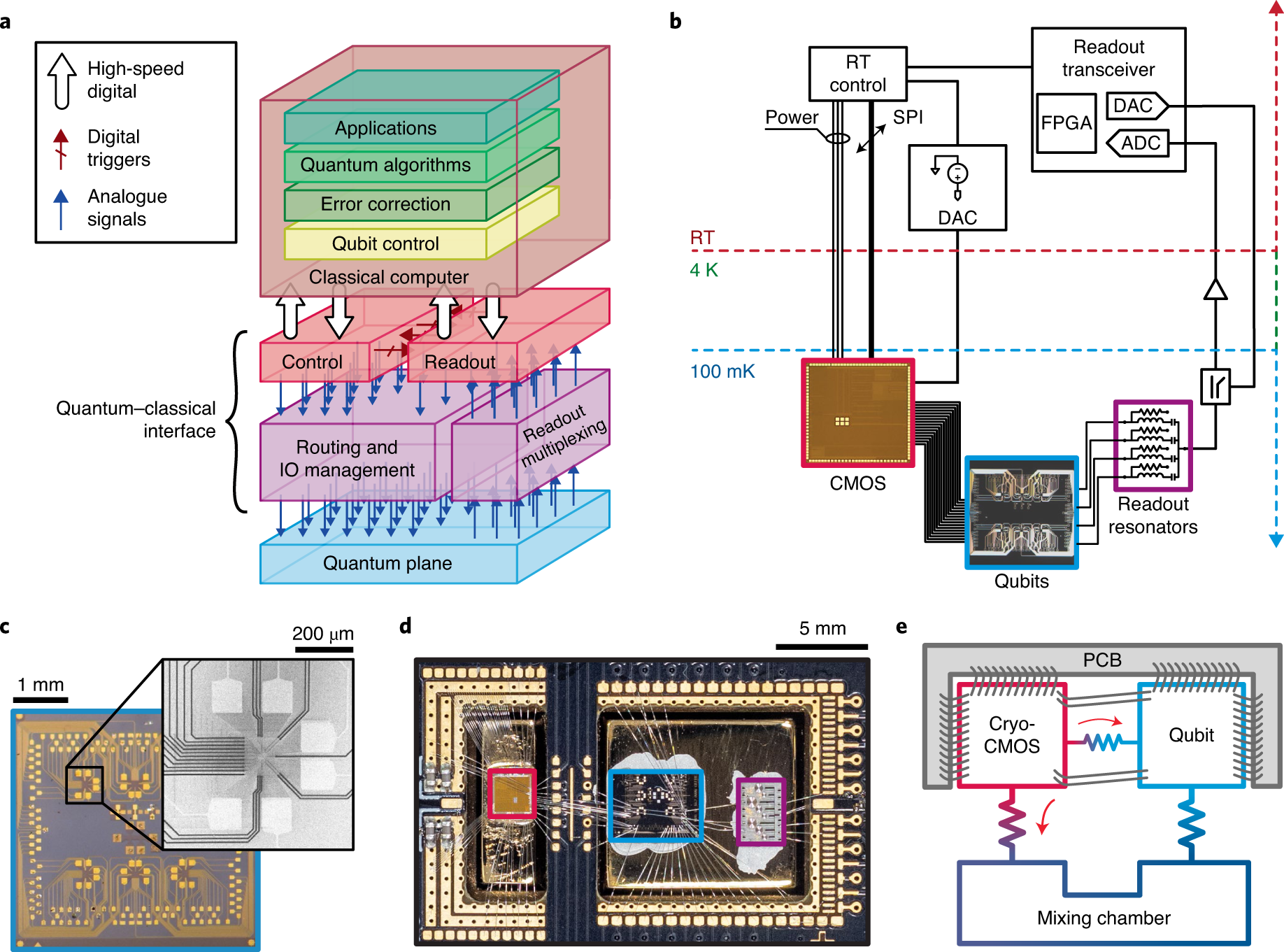
The electronics that generate the control pulses which manipulate qubits and read their state back out rely on cryo-CMOS (Cryogenic Complementary Metal-Oxide-Semiconductor) for expansion. Traditional room-temperature set-ups often require too many wires as qubit counts increase, leading to heat loads and space limitations. Every method of quantum computing, from superconducting to trapped ions, needs a control system. While cryo-CMOS is nearly invisible to the final product, it is decisive for scaling. Companies competing to add qubits must first figure out a way to create control systems to wire up the qubits.
What It Is
Unlike traditional bits, a qubit isn't run by software so much as physically nudged. To compute, precisely timed microwave pulses or laser pulses are fired to flip a qubit, entangle it with a neighbor, then measure the result. The hardware that generates and reads these pulses, namely signal generators, arbitrary-waveform generators, and digitizers, represent the control layer. Currently, such hardware exists in room-temperature racks and reaches the qubits through coax cables, at a rate of very roughly a couple of cables per qubit. Cryo-CMOS technology means rebuilding the control circuit to run cold, allowing a rack of room-temp gear to collapse down into a chip. Two competing flavors: cryo-CMOS transistors, ordinary silicon logic re-engineered to keep working at 4 kelvin (Intel, SemiQon), and superconducting logic, control circuits built from superconductors that give off almost no heat and can sit right at the qubits (SEEQC). Both chase the same prize — generating the control signals in the cold without producing enough heat to cook the qubits.
Why It Matters
As quantum computing starts its journey of commercialization, the barrier to scale is not marketing, rather it is the physics and the technology. Traditional control cable from a room-temperature rack down to the millikelvin processor carries heat in with it and takes up space, with both elements requiring massive financial investment and technological innovation to solve, representing a massive barrier to scale.
While the science is complicated, the math is simple. Conventional wiring breaks down around 150 qubits before the heat can no longer be contained in the system. For maximum fault tolerance, the element that makes quantum important and unique in the first place, millions of qubits will be needed. Room-temperature control becomes physically impossible, so Cryo-CMOS is the only way forward for quantum computers. It turns one-cable-per-qubit into logarithmic scaling, similar to how qubits themselves scale exponentially compared to regular bits. Intel's architecture, for example, is designed to compress 1 million qubits into 20 cables. Such control of cooling infrastructure is important, as whoever controls the cold controls the gold mine of commercial-scale machines. Like how the most important companies in AI are moving away from software into hardware, quantum will experience the same revolution eventually. The most important company in quantum computing may not be building a quantum computer at all.
The Basket
Currently, no major public companies are specialized in the niche of cryo-CMOS development, mainly because it remains a niche that still will not be profitable until quantum commercializes and scales. However, certain mega corporations have started their investment into cryo-CMOS developments, and private companies seeking to establish control of the sector have also started to pop up. The main public corporations investing in the niche are Keysight and Intel.
- KEYS (Keysight): Keysight, an electronics company by classification, has been key in developing currently existent quantum control systems. In July 2025, it delivered the world's largest commercial quantum control system, with over 1,000 qubits, to Japan's AIST.
- INTC (Intel): Intel, the chips giant that has recently fallen behind TSMC, AMD, and NVIDIA, seeks to rebuild their niche around the quantum industry. Over the years, it has developed multiple quantum control systems, highlighted by Horse Ridge (2019), Horse Ridge II (2020), and Pando Tree (2024).
On the other hand, there are a plethora of private companies developing quantum control systems as their specific niche, or as a part of their larger pursuit of quantum computing industry as a whole.
- SEEQC: Single-Flux-Quantum superconducting logic. Developed the first full-stack superconducting quantum computer with integrated digital control with a 5-qubit processor with >99.5% single-qubit fidelity. Has been in partnership with NVIDIA since 2023.
- Quantum Machines: Built the OPX control platform which scales towards over 1000 qubits. Receiving nearly $300 million of total funding from investors for their product and has co-developed NVIDIA's DGX Quantum.
- Qblox: Develops modular qubit-agnostic control units. Backed by their national-lab with open-source stack going commercial.
- Zurich Instruments: 1,000+ channels per rack, microsecond real-time feedback for error correction.
- SemiQon: Developed cryo-CMOS transistors optimized 99.9% less power and 1,000× less heat.
What to Watch
As with most emerging technologies, the milestones will be the main thing to watch for cryo-CMOS. Cold control systems will most certainly be the future of quantum control systems as quantum computers scale to the qubits that make them commercially viable, and it remains to be seen whether cryo-CMOS can exceed, catch up, or fall behind the qubit expansion. On the business side of things, any attempts at vertical integration from quantum computing firms will be interesting, and will certainly involve a partnership or acquisition linking a control startup (SEEQC, Quantum Machines) to computer-maker. As developments of quantum computers ramp up, quantum computing firms will certainly start thinking about securing the best supply chain of control units before their competitors, and the private firms controlling cryo-CMOS will certainly be bid upon based on their successes.
The Takeaway
While quantum computers expand qubit counts, the control systems behind them rely on cryo-CMOS to match that expansion. Most companies focused on the niche, with proven successes, are privately owned and operated as the industry is not commercially viable yet, and will wait even longer than the computers themselves to see revenue daylight. However, these private firms such as SEEQC and Quantum Machines are still important to watch, as possible partnerships will determine which quantum computers will have a secure control system chain, and which ones will scramble for a long-term scaling solution.