Chokepoint: Quantum Computers
· The Stack · 5 min read
By Victor Chen
The Layer
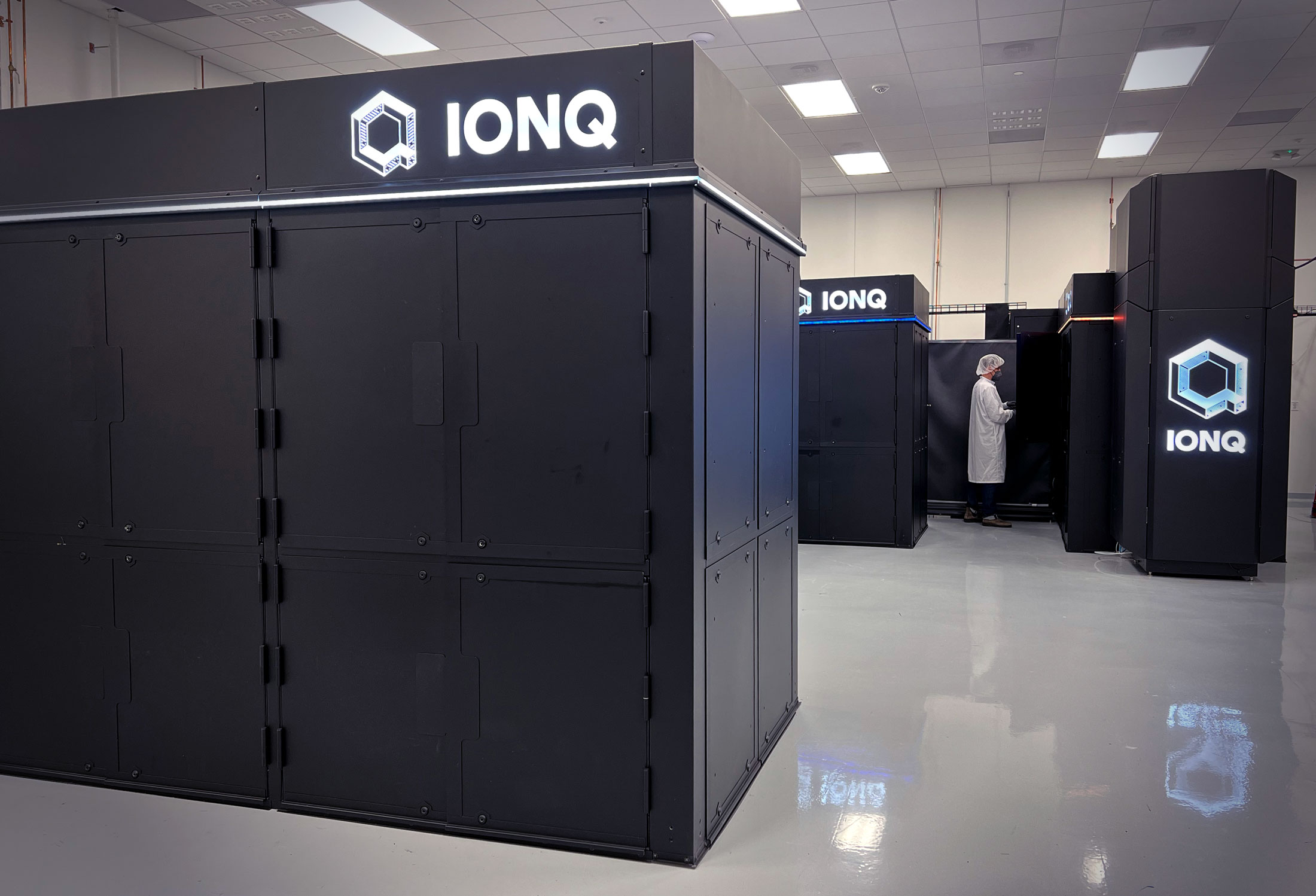
The quantum computers themselves happen to be the most competitive and complicated part of the quantum supply chain. These machines are the most visible to the public, attracting attention and investment into the various companies, from specialists focusing on its own specific technological niche, to tech conglomerates aiming to dominate yet another part of the industry.
Specialists in the field, such as IonQ, Rigetti, D-Wave, and Quantum Computing, all rely on specific niches to outcompete others based on technology. They inherently cover more risk, as their success largely relies on finding a way to expand and grow their specific niche into market dominance. Conglomerates, on the other hand, are trillion-dollar names treating quantum as one more frontier to dominate. They rely on more traditionally proven methods and are more conservative in their quantum development journey. To date, no modality has won. Trapped ion, superconducting, annealing, photonic, and silicon spin, which are the main technologies behind quantum in the status quo, are all still live bets. Each approach leans on the supply chain differently, with superconducting and silicon spin being hostage to cryogenics and isotopes, which will be covered later in the stack, while trapped ion less so but still susceptible to its own separate challenges.
What Is It
To understand the different quantum computing technologies, a basic understanding of quantum computing as a whole must be had. A regular computer runs on bits, which are switches that are either 0 or 1. Everything it does is a very fast sequence of those two states. A quantum computer runs on qubits, and a qubit can be 0, 1, or anything in between thanks to a special quantum property called superposition.
Chain qubits together through entanglement, where their states are linked so measuring one instantly tells you about the others, and the machine can hold and process an exponentially larger set of possibilities in parallel. Two qubits track four combinations at once; three track eight; three hundred could, in principle, represent more states than there are atoms in the universe. In essence, qubits allow for exponential growth rather than linear growth in traditional bits.
Contrary to common belief, a quantum computer is not a faster version of your laptop. For email, spreadsheets, or most software, it's useless. Its advantage shows up only on a specific class of problems where you have to search an enormous space of possibilities at once such as through simulating molecules for drug discovery and materials, optimizing complex systems like logistics or portfolios, and breaking the encryption that protects the modern internet. On those, a working quantum machine could do in minutes what the best supercomputer couldn't finish in the entire lifetime of the universe.
The reason none of these companies is minting money yet comes down to one word: errors. Qubits are fragile, so a stray vibration, a flicker of heat, a stray magnetic field, and the delicate superposition collapses and the calculation is ruined. Today's machines make mistakes far too often to run those world-changing algorithms. The entire industry is now racing toward fault tolerance by incorporating many imperfect physical qubits into a few reliable "logical" ones that catch and fix their own errors. The race for fault tolerance is the race for industry dominance.
Why It Matters
Quantinuum's IPO showed that the speculation around these corporations are reaching record highs. Post-June, the whole group is being repriced on a "revenue proof” test, with prices trading at from over 50 to 500 times sales amounts. The Quantinuum's June 4 IPO is Honeywell-backed, institutionally credible, and raised $1.68B, which dragged the whole sector's speculation to record highs and, in doing so, forced a benchmark. While these corporations are generating valuations, only IonQ truly has the revenue data to back it up. It is the leader in commercialization to date, as everyone else is a science project at a venture valuation currently.
The Basket
There are 5 main types of quantum computing methods: trapped ion, superconducting, annealing, photonics, and silicon spin, each with their own advantages and differing slightly on supply chain reliance.
- Trapped Ion
- IONQ: 256-qubit system sold to Cambridge.
- QNT (Quantinuum): Helios (98 physical / 48 logical qubits), 99.921% fidelity.
- Superconducting
- RGTI (Rigetti): Cepheus-1-108Q: 108 qubits, 99.8% median fidelity.
- IBM: Nighthawk (120 qubits).
- GOOGL (Google): Willow (105 qubits).
- Annealing
- QBTS (D-Wave): Advantage2 (~4,400 qubits).
- Photonic
- QUBT (Quantum Computing): Dirac-3 (thin-film lithium-niobate photonics).
- XNDU (Xanadu): Aurora (12 qubits, with real-time error decoding).
- Silicon Spin
- INTC (Intel): Tunnel Falls (12 qubits).
Trapped Ion
Trapped ion technology relies on individual charged atoms (ions) suspended in a vacuum by electromagnetic fields and manipulated with precisely tuned lasers. Since every qubit is an atom, they're identical and hold their state a long time, which is why trapped-ion machines post the best error rates. However, the laser choreography is slow, so gate operations run orders of magnitude slower than other quantum computing methods, and scaling past a few dozen ions in one trap is hard.
Superconducting
Superconducting relies on tiny superconducting circuits printed on a chip, chilled to near absolute zero so electricity flows with zero resistance and the circuit behaves like an artificial atom. Controlled with microwave pulses, they switch extremely fast and are built with familiar chip-fab methods, which is the reason IBM and Google chose this path. However, the qubits are fragile and lose their state quickly, and the whole chip only works inside a millikelvin dilution fridge, chaining it to the cryogenics and helium-3 chokepoints downstream.
Annealing
Instead of running a universal program, an annealer is purpose-built to find the lowest-energy answer to optimization problems. It sets up a physical energy landscape and lets the system settle into its minimum, like water finding the lowest point. That lets it field thousands of qubits today, far more than gate-model machines. However, that means it can only do optimization-style problems but it can't run the algorithms that make quantum famous. As such, it seems to target a niche within the quantum niche.
Photonic
Photonic encodes qubits in particles of light (photons) moving through waveguides on a chip, instead of matter held near absolute zero. Photons barely interact with their environment, so much of the system can run at or near room temperature and it slots naturally into fiber-optic networking. However, photons also barely interact with each other, which makes two-qubit gates hard, and the single-photon detectors still need deep cooling so it trades one cryogenic problem for another.
Silicon Spin
Silicon spin stores the qubit in the "spin" (a magnetic up/down property) of a single electron trapped in a silicon transistor which is essentially a quantum bit built with the same manufacturing the entire chip industry already runs at scale. That gives it the clearest path to mass production and the smallest qubit footprint. However, it remains to be the most undeveloped approach, and the silicon has to be isotopically purified to silicon-28 (stripping out the spin-carrying silicon-29) or the qubit loses coherence, which ties it directly to the isotopes chokepoint.
What to Watch
It is key to watch the sales-multiple compression across the group, as the market tries to gage a realistic long term valuation for the stocks. The conversion of backlog/bookings is key in converting market valuation into recognized revenue. Cash runway is key as well, as the development of systems, vertical integration, etc are all key steps before successful commercialization, which is the end goal of all these major quantum computing firms.
Technologically speaking, comparing the real trendlines to projections released in the past few years is key, as many companies, such as IonQ, set ambitious goals in its logical-qubit / error-correction milestone. Since the technology is still in a developmental stage, it remains to be seen if there could be any roadblocks that develop as the tech scales, qubits are added, and fault tolerance is pushed towards its limits. While the high sales-multiple in market valuations signals that investors have belief in the industry to persevere, it remains to be seen if bottlenecks or chokepoints identified can be solved in the long-term, or will continue to slow down the industries progress towards widespread adoption and commercialization.
The Takeaway
The simplest takeaway from this bottom layer of the quantum supply chain is that: the technology is underdeveloped and market valuations are only speculations. While some companies have more developed methods, others have more developed revenue streams, still others have massive untapped potential for growth. The volatility within these quantum stocks reflects this uncertainty. The most public layer is the most competitive and the least defensible. Stocks will rise, stocks will fall. The industry thrives on excitement, setback, and one word: uncertainty. As long as fundamentals are uncertain, as long as methodologies are still indefinite, there will be no certainty in the quantum computing industry, just like the qubits itself.