Trump tariffs struck down by US Supreme Court. What’s next?
· Current Events · 5 min read
By Victor Chen
The News
On February 20, 2026, the U.S. Supreme Court struck down President Trump's "reciprocal" tariffs in a 6-3 ruling, deeming them an overreach of executive power under the International Emergency Economic Powers Act (IEEPA). In response, Trump signed an executive order imposing a new 10% global import tariff under Section 122 of the 1974 Trade Act, quickly hiking it to 15% the next day as "fully allowed and legally tested." By March, Customs and Border Protection status updates confirm ongoing implementation of the executive order.
Context
Trump has long pushed for tariffs in his second term, with liberation day last April being the most significant action taken during this policy agenda. Amid $1.1 trillion annual 2026 trade deficits, Trump has decided to ramp up the use of tariffs to balance the deficit by limiting foreign imports. Prior IEEPA tariffs generated $200B+ revenue but faced lawsuits from businesses/states seeking $170B refunds. Following the deeming of IEEPA tariffs as illegal and executive overreach, the case for refunds on prior tariffs have grown significantly stronger.
In the meantime, Trump bypassed the court decision on ending tariffs via Section 122, although the future legality of such executive orders, including whether they survive congressional overview, remains to be seen. Section 122 of the Trade Act of 1974 empowers the U.S. President to impose temporary, up to 15% tariffs or quotas on imports for up to 150 days to combat severe, fundamental international payments problems, such as a major balance-of-payments deficit or rapid dollar depreciation. Any longer extension of the tariffs beyond 150 days will require congress to pass legislation.
Immediate Cause
The Supreme Court decision came as a result of the court's rejection of IEEPA authority, affirming Congress's sole tariff power per the Constitution. Businesses argued tariffs illegally hiked costs without congressional buy-in. Under the U.S. Constitution, tariffs are a congressional power. Article I, Section 8 authorizes Congress to "lay and collect Taxes, Duties, Imposts and Excises". While the IEEPA was one of the methods the President is granted by Congress to implement tariffs, its usage is severely limited for extreme emergencies. Even under the IEEPA, Congress still has ultimate power under the constitution to overturn Presidential tariffs with a two thirds majority assuming the President vetoes to keep his own tariffs. In this case, no Congressional overturn was necessary as the Supreme Court ruled the action incompatible with the IEEPA law in the first place.
Effect
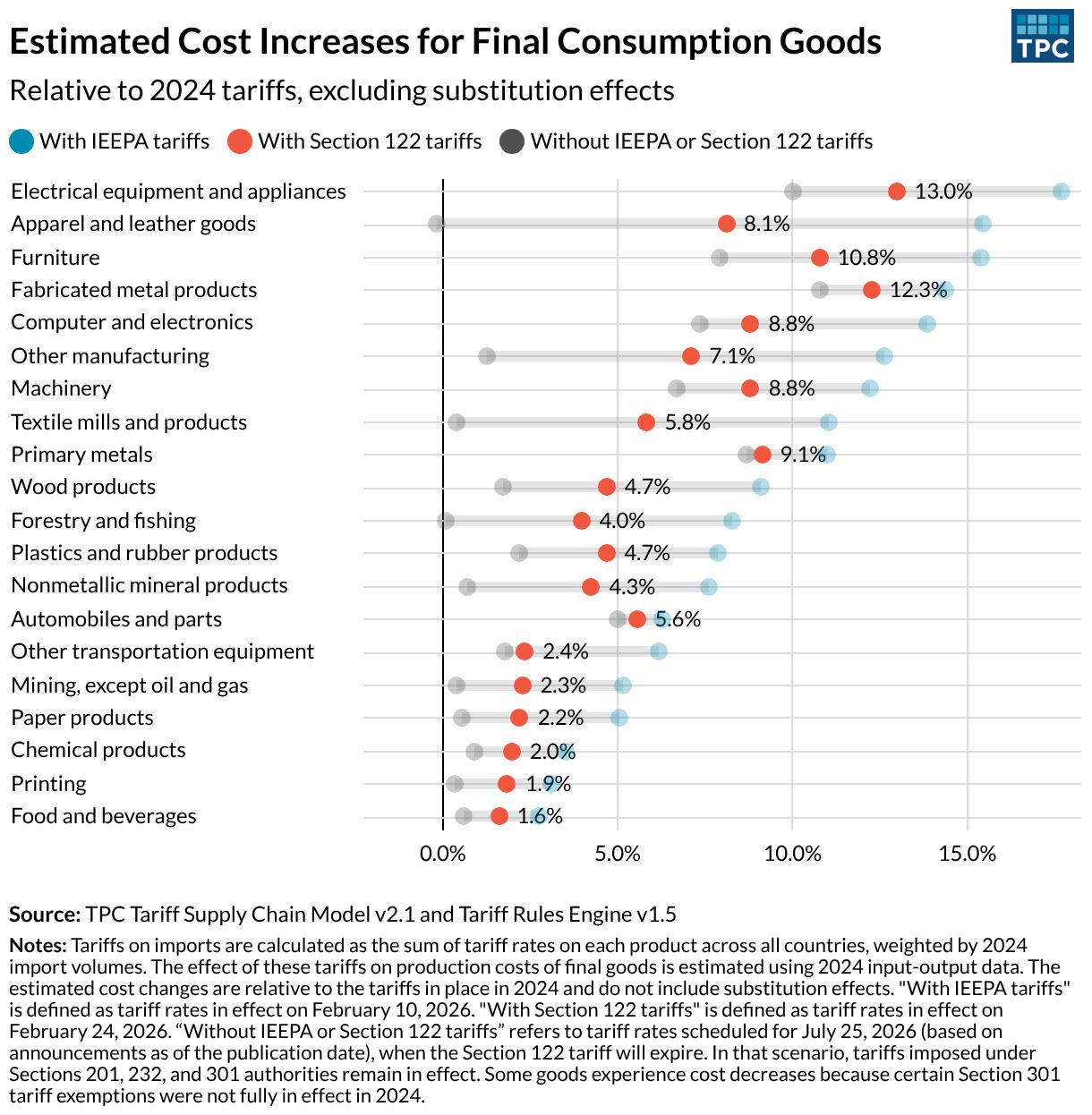
The immediate fallout of the new tariffs is a $170B refund obligation on the Treasury. The tariffs are expected to face retaliation, as China/EU continue to implement countermeasures such as supply chains reroutes through unaffected nations. Notably, the Section 122 tariffs are less severe compared to the IEEPA tariffs, with costs falling for most goods. However, consumers and producers alike continue to pay the price as over 90% of US tariffs are burdened domestically, according to a Federal Reserve Bank of New York research on 2025 numbers. The following chart from TPC shows a visual of the differing effects of the tariffs, compared to the natural cost increase of the goods without the tariffs.
Market Impact
The implementation of new tariffs has increased inflation expectations, causing the Fed to pause and delay cuts. Retail stores continue to feel the costs, while domestic industries and transportation margins expanded. Commodities surged, as Gold rose by 1.7% while Silver rose by 5%. VIX reached a high of $28 dollars, showing heightened market uncertainty surrounding the current volatile political climate.
So in short, while the world is hyperfocused on the situation in the Middle East, long-term agendas that have significant market impact have not disappeared. The Trump tariffs, including his position, have shifted significantly since the onset of the administration, and there is no easy way to say what may come next. The best course of action is to watch and react rationally and move with caution.